Sophia Hurtado Solano - Epigenetic potential and migration propensity in Eurasian Passer sparrows
Home institution
U Icesi, Colombia.
Host institution and supervisors
Mark Ravinet. UiO, Norway. 2024-2026.
Blanca Jimeno. Doñana Biological Station (EBD-CSIC), Spain
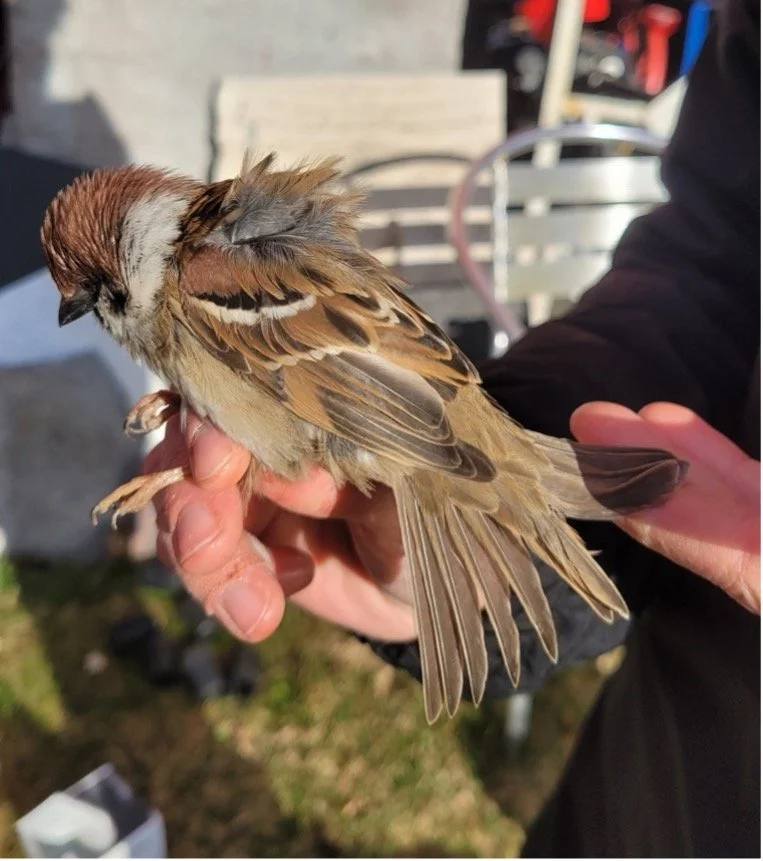
Field work collecting data from house and tree sparrows in Oslo.
Project description
Epigenetic potential is defined as the susceptibility of a genome to show epigenetic processes that may mediate phenotypic variation. One of the most studied epigenetic mechanisms is DNA methylation, which in vertebrates occurs almost exclusively in cytosines that occur before guanines (i.e. CpG sites) within the genome. The number of CpG sites appearing in the genome show variation among individuals and species. Therefore, this number may be considered a form of epigenetic potential, under the prediction that an increased number of CpG sites could allow for more DNA methylation to occur, which can modulate gene expression and as a result, plasticity. As such, individuals and/or populations facing novel environments may benefit from having a higher epigenetic potential, due to phenotypic plasticity being adaptive in such contexts. For example, this epigenetic potential has been suggested to facilitate range expansions in species like the house sparrow (Passer domesticus), where in initial invasions a high epigenetic potential may be selected for, and wanes as populations adapt to the new environments. Furthermore, Passer sparrows present a wide range of migratory behaviour patterns (another type of dispersal behaviour) which could point to a high degree of phenotypic plasticity at both intra- and interpopulation levels, making it a good novel target of study for epigenetic potential through whole genome comparisons. Previous studies evaluating epigenetic potential via CpG site number in the house sparrow have mainly focused on specific immune genes or genome regions, but whole genome evaluation for this trait has not yet been conducted, nor has it been looked at when comparing closely related species. Therefore, to investigate whether epigenetic potential is a selected trait linked to dispersal behavior like migration, it is fundamental to examine epigenetic potential across many gene regions in the entire genome for these species.